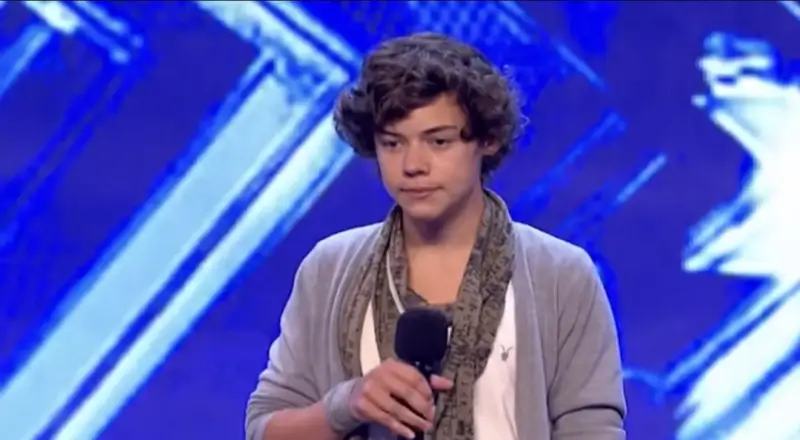
The audition that opened the door to a new pop era
Every huge music story has a starting point, and for modern pop, that point was a television audition room. A newly shared extended version of The X Factor UK now gives fans a closer look at 16-year-old Harry Styles at the very beginning of his journey. Before the arenas, the headlines, and the worldwide fame, he arrived as a bright, curly-haired teenager from Holmes Chapel in Cheshire.
He made an immediate impression. Smiling easily, he explained that Saturdays were spent working at a local bakery. He even joked about the shop’s popular treats. Just after finishing his GCSE exams, he decided to “give it a whirl,” stepping into the room with a calm confidence that felt natural rather than rehearsed.
Key Insight: The moment stood out because it felt personal, modest, and full of early promise.
Harry had already enjoyed a small taste of success. He and his school band, White Eskimo, had won a local battle of the bands contest. Even so, he wanted something bigger than a hometown win. His mother had long encouraged his singing, but he wanted the opinion of people who worked in the industry. That was the real test he had come for.
The performance itself took an unexpected turn. He first started Train’s “Hey, Soul Sister,” but the backing track was too busy for his voice to come through clearly. Nicole Scherzinger quickly stepped in. Then Simon Cowell asked him to continue without accompaniment, giving his voice room to stand on its own.
- Harry moved from a polished backing track to a bare vocal performance.
- He chose Stevie Wonder’s “Isn’t She Lovely.”
- His warm tone and rough-edged softness won attention right away.
Once everything was stripped back, the 16-year-old delivered an unaccompanied version of Stevie Wonder’s “Isn’t She Lovely.” The result was striking. His voice carried a slightly raspy warmth, and his phrasing felt gentle and effortless. Instead of sounding polished in a commercial way, he came across as naturally magnetic.
The judges did not agree immediately, though. Nicole Scherzinger praised his tone and obvious potential straight away. Louis Walsh disagreed and voted no, saying Harry seemed too young and not fully ready for the pressure of live television. The audience reacted loudly, drowning the rejection in a wave of boos.
“Sometimes the first impression is only the beginning, not the full story.”
Simon Cowell then shifted the outcome. He matched the audience’s reaction and backed Harry’s charisma, pointing out that training could shape him into something remarkable. His yes vote became the deciding one, sending Harry through to the next round.
That choice mattered far beyond one audition. The performance helped set in motion the chain of events that would later lead to One Direction and push Harry Styles toward worldwide recognition. Looking back, the clip captures the exact moment an ordinary teenage hopeful began turning into a global star, and it remains one of pop’s most important early milestones.
In conclusion: Harry’s first major audition combined youth, charm, and raw vocal promise in a way that few people could ignore. What began as a simple tryout became the opening chapter of a career that would soon reshape popular music.